Background
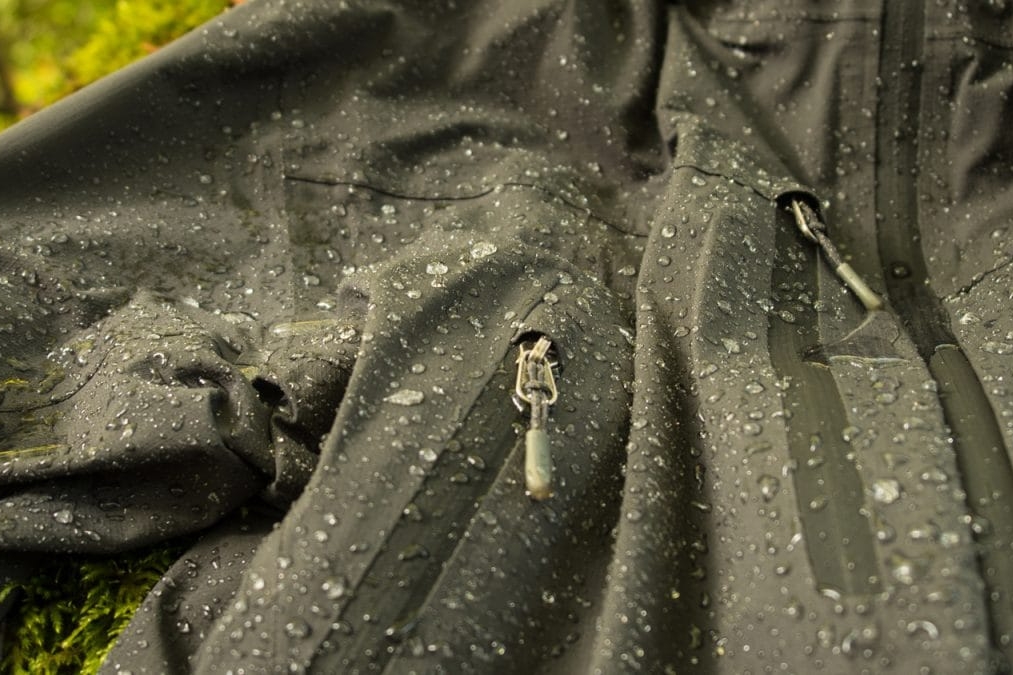
Most jackets marketed as “waterproof” need to be washed to maintain ideal performance. They’re made with multiple layers, and the outermost is normally a fabric coated with a durable water repellant (DWR) treatment. While the membrane underneath that fabric actually makes the jacket waterproof, the fabric (including the DWR) makes wearing the jacket more pleasant by causing water to bead up and roll off the surface.
When that happens, it frees up surface area for air and water vapor (from sweat) to pass through the jacket and away from your body. This is what manufacturers mean when they say their rain jackets are “breathable” versus a solid hydrophobic outer layer that basically doesn’t breathe (like Columbia’s OutDry). Neither design is inherently better or worse than the other, they’re just made for different scenarios/uses.
When the DWR coating on a jacket gets less effective due to use/wear, water stops beading and starts soaking into the outer fabric. When this happens, it’s called “wet-out.” Theoretically, this shouldn’t compromise the waterproof nature of the jacket (the membrane under the fabric is what keeps water out). I personally don’t think that’s always the case, but that’s another post. What’s definitely true is when that outer fabric gets soaked, it creates a layer that traps the warm air and sweat vapor that would normally escape through the jacket’s membrane and fabric. This results in you feeling hotter and more clammy while wearing the jacket.
This is expected with normal use, and the solution is to wash the jacket to remove oils or other residue that might be interfering with the DWR coating, then “renew” it. After that, water should bead and roll off again, restoring breathability. Two ways to do this at home:
- Wash-based solutions
- These are used in combination with or in place of regular laundry detergent when putting the jacket through a washer and dryer
- This is what I’ll be discussing in this post
- Spray-on solutions
- These come in a spray bottle and are manually applied to the jacket in addition to a wash
- I’m not very familiar with these, so I won’t be covering them, but they’re out there if the solutions covered here don’t work for you for whatever reason.
Important: many jackets that aren’t waterproof have a DWR outer coating. These are normally marketed as “water resistant” because they don’t have a waterproof membrane under the outer fabric. When the DWR coating is compromised, these jackets soak all the way through. This doesn’t require a breakdown of the coating due to wear: anything that traps water on the fabric will eventually cause water to get through the coating. Backpack straps are probably the most common example.
My Situation
I have a fairly large jacket collection for a few reasons, and I currently have five that I treat annually with a DWR renewer:
- Arc’teryx Atom (water resistant)
- Mountain Hardwear Kor Airshell Warm (water resistant)
- Mountain Hardwear Kor Stasis Hoody (water resistant)
- Mountain Hardwear Stretch Ozonic (waterproof)
- Under Armour Forefront (waterproof)
I have a front-loading high-efficiency washer and dryer set. If you have a top-loading set, you’ll have more flexibility with load sizing when using Nikwax, so much of what follows won’t apply to you.
Grangers Wash + Repel 2-in-1
This is the solution I used for several years, primarily because it only takes one wash cycle to (mostly) apply according to the directions on the bottle. Paraphrasing to account for a graphic:
- Add two capfuls (100ml) for the first garment
- Add 50ml per each additional garment
- Shake bottle and pour into washing machine drawer
This acknowledges that most washing machines can fit many jackets (or other garments), so the approved usage allows washing many pieces. Each bottle is 300ml, which is enough for five garments. How convenient for me.
The drawer capacity of my washing machine is not nearly large enough to accommodate 300ml of liquid. At most, it’s a little over 100ml. However, when I pour the recently-shaken liquid into the drawer, it quickly drains down, presumably into the drum or a separate holding area. Because of this, I can eventually pour the entire bottle in. I’m not 100% sure this falls within the intended usage, but it’s what I’ve done for years with good results.
Nikwax Tech Wash and TX Direct
If you do a search for DWR renewers, this will probably be the first one that pops up, or at least the one that’s mentioned the most. When someone asked about DWR renewal in my ultimate frisbee team’s Discord (lots of outdoorsy people), this was the most popular answer. I tried it this year over Grangers because I was overdue for my annual treatment, and the closest outdoors store only had Nikwax in stock.
It comes in a pack with two bottles: one cleaner (Tech Wash), and one waterproofer (TX Direct). Directions for front-loading sets:
- Place maximum of 2 garments in the washing machine
- Add 100ml of Tech Wash/TX Direct
- Select a normal cycle using warm/cold water and extra rinse if possible
Both bottles specifically state that only two garments can be treated at a time. This differs significantly from Granger’s “100ml plus 50ml per additional garment” instructions.
The Process
Since I was using a new product, I figured it would be worth checking the performance of the previous one to compare. I put the outer forearms/elbows (high-wear areas) of all five jackets under a cold tap to see how well the DWR coating worked after a year of use. Full disclosure: the newest jacket was purchased in December of 2024 (UA Forefront), so it was still on the factory coating, not Grangers.
Water beaded on all of them, and when I created a small divot/basin in the sleeves and let water sit in them for 10-15 seconds, none showed any signs of wet-out. Based on how quickly the beads traveled, the MH Stretch Ozonic was the most hydrophobic, while the MH Kor Stasis was the least. No surprise there: the Ozonic is a 2.5-layer that I only use a handful of times a year while the Kor Stasis is my favorite midweight jacket that gets used a few dozen times a year. To be clear: the DWR coating on the Kor Stasis was still fully functional; the water beads were just quicker on other jackets. With that informal testing done, it was on to the laundry room.
There was a multiplicative effect because of 1) the separate bottles and 2) the hard limit on garments per load. An extra rinse and extra drying time (to set the DWR coating) are recommended for all products, and I used the Delicate setting for both wash and dry per the care instructions on the jackets. I cheated a bit by including three garments in the second load because doing a whole additional one for one jacket seemed dumb.
Grangers (last year)
- Load 1 wash (5 garments) – 48 minutes
- Load 1 dry (5 garments) – 30 minutes
Total ideal time: 1 hour, 18 minutes
Nikwax (this year)
- Load 1 wash with Tech Wash (2 garments) – 48 minutes
- Load 1 wash with TX Direct (2 garments) – 48 minutes
- Overlap
- Load 1 dry (2 garments) – 30 minutes
- Load 2 wash with Tech Wash (3 garments) – 48 minutes
- Load 2 wash with TX Direct (3 garments) – 48 minutes
- Load 2 dry (3 garments) – 30 minutes
Total ideal time: 3 hours, 42 minutes
Of course, laundry doesn’t take constant attention, so a nearly 3x increase in time isn’t as bad as it seems at first glance. However, it’s common for me to finish a scene while watching a show or finish a level while playing a video game after hearing the washer/dryer chime. I also might leave the house or do other chores for a short time. So in real life, the whole Nikwax process probably took close to five hours.
Which brings up another metric: trips to the laundry room. The described Grangers process requires three: put the load in the washer, swap the load to the dryer, take the load out the dryer and hang it up. The described Nikwax process requires six trips to the laundry room if I ignore the Load 1 dry notification and wait for the Load 2 Tech Wash wash to finish before hanging up Load 1 garments.
It’s also worth noting that in terms of water usage, Nikwax requires at least double the loads for front-loading washers because of the separate washes for Tech Wash and TX Direct. If you strictly follow the instructions on the bottle, the number of required loads goes up by two for each pair of garments. As noted, I fudged things a bit by including three jackets in the second load, so the water usage ratio was “only” 1:4 compared to Grangers.
Based on my subjective assessment of a second round of the tap test, four of the jackets were more hydrophobic after going through the Nikwax process (the Ozonic was already basically pristine).
Thoughts
Unless the results of the tap test next year blow me away, I’ll be going back to Grangers. It accomplishes the goal while taking roughly 1/3 of the time (in the real world) and 1/4 or less of the water to apply when mostly following the directions of both products. I also think Nikwax leaves more of a scent, though that dissipated pretty quickly (a couple weeks on a hanger or 1-2 uses).
Some factors that might be relevant for other people:
- While I do wear some of my jackets a lot (specifically the Kor Stasis and Atom), I’m not very hard on them. Sure, they get shoved into duffel bags, and my elbows constantly rub on my console/door while I’m driving, but I’m not wearing them while climbing scree or going up rock faces. If one of the solutions is more durable than the other, I wouldn’t know it because I don’t cause enough wear to push them to their limits.
- If treating five garments at a time with Grangers causes incomplete or inconsistent coverage, that would mean splitting into two loads, which would shrink the time and water usage gaps significantly. I haven’t noticed any issues with a five-jacket load, but again, I’m not pushing the garments or the DWR coating very hard in the grand scheme of things.
 Evening Latte
Leave a comment