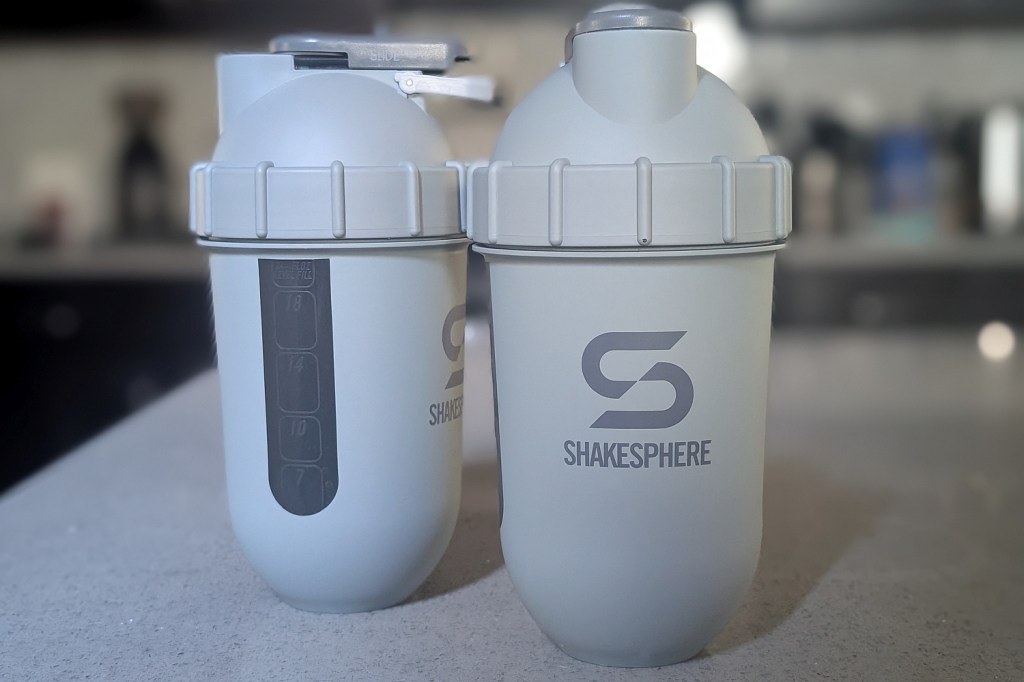
Most of us need more protein than we get from our normal diets, and powders are an easy way to supplement (my favorites are listed here). Most powders don’t mix well enough for a spoon to suffice, so shaker bottles exist.
The pitch from Shakesphere is basically that corners in shaker bottles are bad. They provide a place for dry powder to clump, meaning it doesn’t get mixed and is a pain to clean out. That matches my experience, so I grabbed a couple of their View bottles during a sale.
For comparison, I’m going to use what I think is a very prevalent/popular option: a BlenderBottle Classic.
Mixing
After using the Shakesphere almost daily for nearly three weeks, I can confirm it mixes at least as well as the BlenderBottle, even without the wire ball. Admittedly, part of that is that I intentionally buy protein powders that mix easily; some online reviewers have reported issues with clumpier powders. But if you use a clumpy powder, you could get a wire ball or even use one from a shaker bottle you already own to get the best of both worlds.
Materials/Build
The BlenderBottle cup has what I consider the standard consumer drinkware plastic feel, and the texture is the same for the inner and outer parts. The lid is slightly smoother.
The outer of the Shakesphere (both cup and lid) is a slightly softer/more rubberized texture, which feels premium and is grippier when wet. Not huge, but noticeable. The inners of both have a glossy texture that further reduces powder clumping, and it’s also supposed to reduce odor retention.
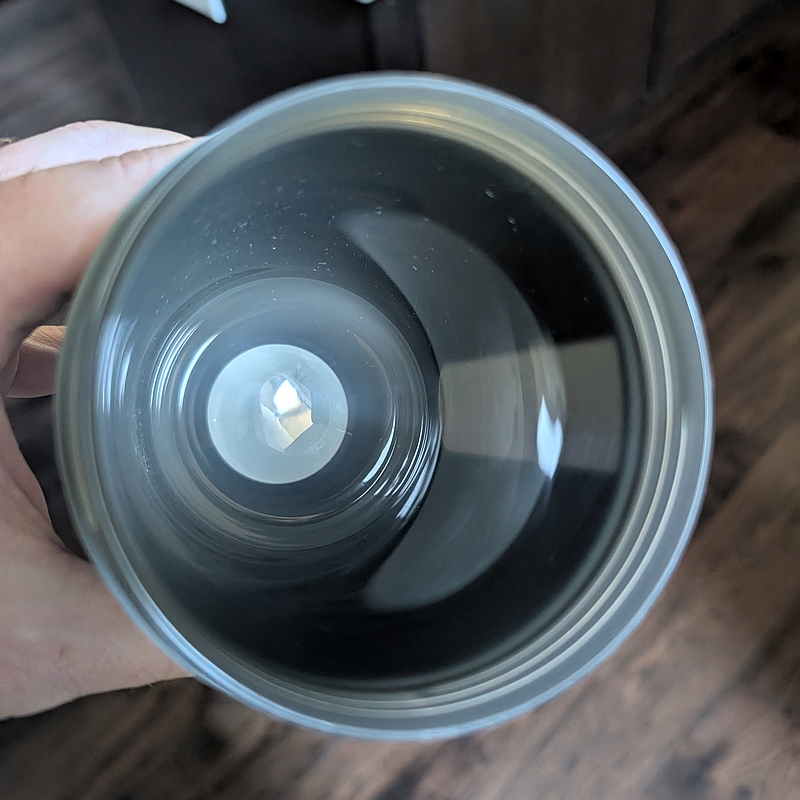
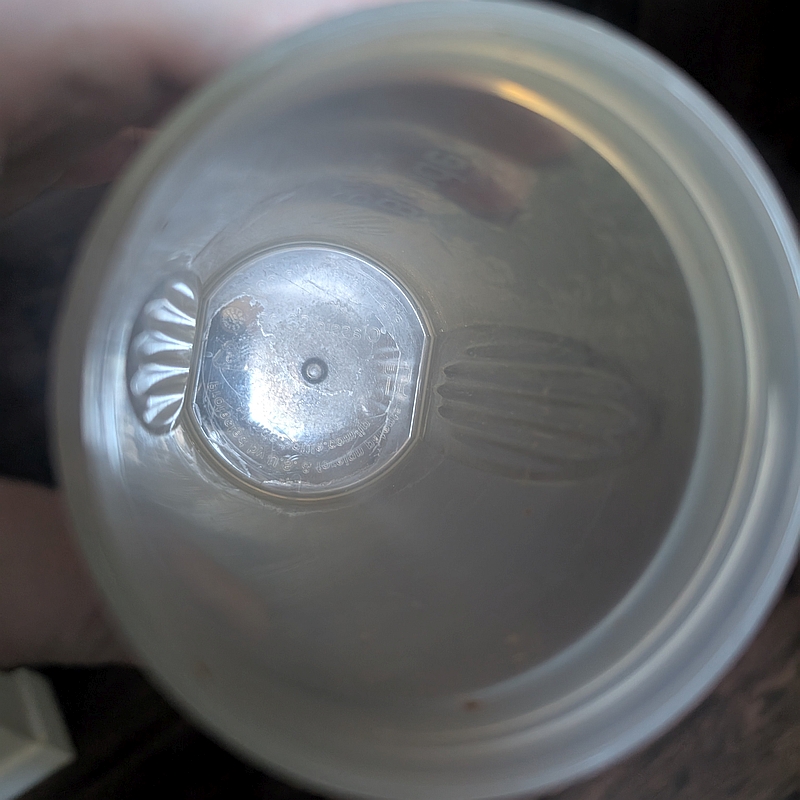
The interior of the lid follows the no-corners principle: everything is rounded, and there are no crevices where powder can get stuck.
My lone build quality complaint about the Shakesphere is the threading between the cup and the lid. The fit of the BlenderBottle is good/clean enough that once the threads are lined up, I can confidently give the lid a quick twist, and it gets to the point of tension where I can tighten to form the seal. In contrast, the Shakesphere has friction catch points in its threading that prevent the lid from rotating smoothly.
For a couple weeks, I thought I was being overly picky, but then one of the catch points caused me to miss the threading at the last second. As a result, instead of twisting the lid on, my thumb sent it flying across the kitchen. Like any threading, it will smooth out over time, but it’s been three weeks, and there hasn’t been a noticeable improvement.
Seals/Leaking
I don’t like the lid on the Shakesphere. The BlenderBottle has a the industry-standard hinged cap that snaps onto the lid spout to make a seal. The Shakesphere uses a sliding cap top with a soft/rubberized bottom that is pressed harder onto the lid spout as it’s closed. Combined with relatively wide spout top edges, it creates a leak-proof seal if used perfectly.
I say “perfectly” because the design is pretty unforgiving. With the hinged cap design, the snap/click is an obvious tactile indicator that the seal has been formed. However, the slide design has no such feedback. The user is responsible for ensuring they push the slide to the full extent of the range, which actually takes a bit of effort since friction naturally increases as the cap closes. See the two pics below; one shows the cap fully sealed, and the other shows a situation where the cap will slowly leak.
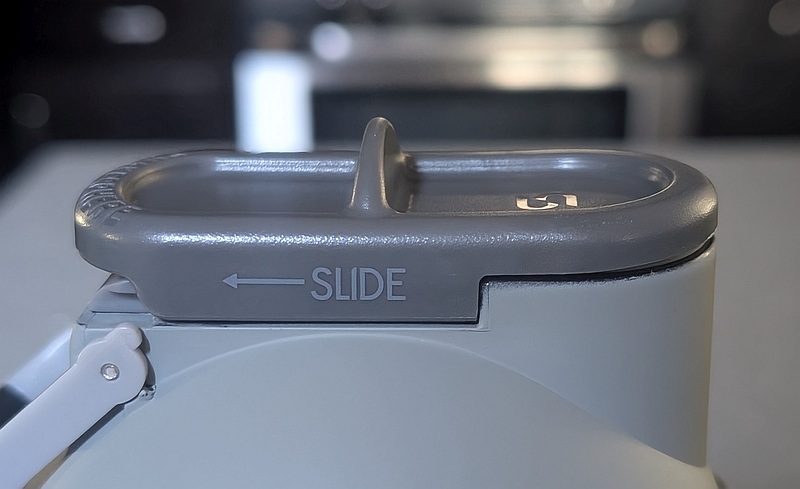
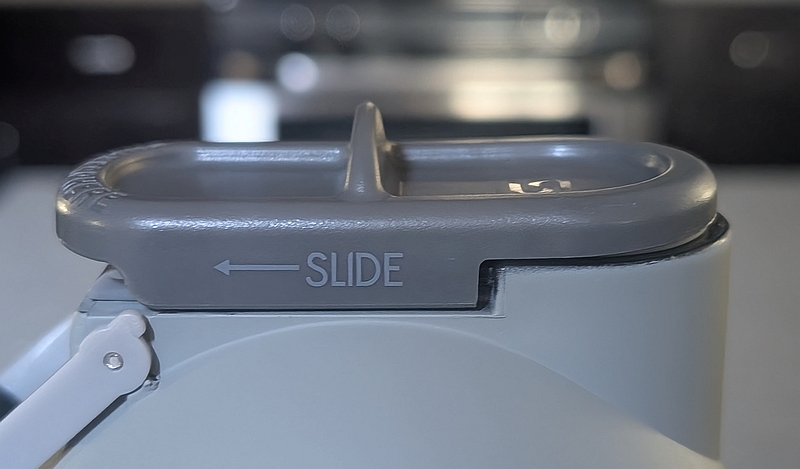
I’m a pretty detail-oriented person, but I’ve already failed to fully seat the cap once before shaking. Not much mixture escaped (I only had to wipe a couple drops from my kitchen floor and rinse off the bottle), but I was in a hurry, so it was pretty annoying. I also wouldn’t trust the design in a situation where I knew my bag would be jostled during transport: a moderate knock against something solid could slide the cap back enough to break the seal. I suppose one could say that same about a snap cap, but the upward motion seems less likely than something simply hitting the edge of this slide cap.
Convenience
Size
I only do basic powder mixing (no smoothies), so I prefer smaller bottles that are easier to fit in gym/bike bags. The Shakesphere 700mL (roughly 24oz) is both taller (~8.25″ vs ~6.75″) and wider (max 11″ cup circumference vs 10.5″) than the BlenderBottle 20oz. The circumference difference might not sound significant, but the Shakesphere’s shape is less tapered, so it doesn’t fit in some vehicle cup holders.
Carrying/Comfort
At first glance, the Shakesphere has a standard hinge loop like the BlenderBottle. However, the first time I took it to the gym, I realized they made the curious choice to limit the travel of the loop. The result: when the cup has liquid in it, my finger gets pinched between the loop and the cap’s slide piece.
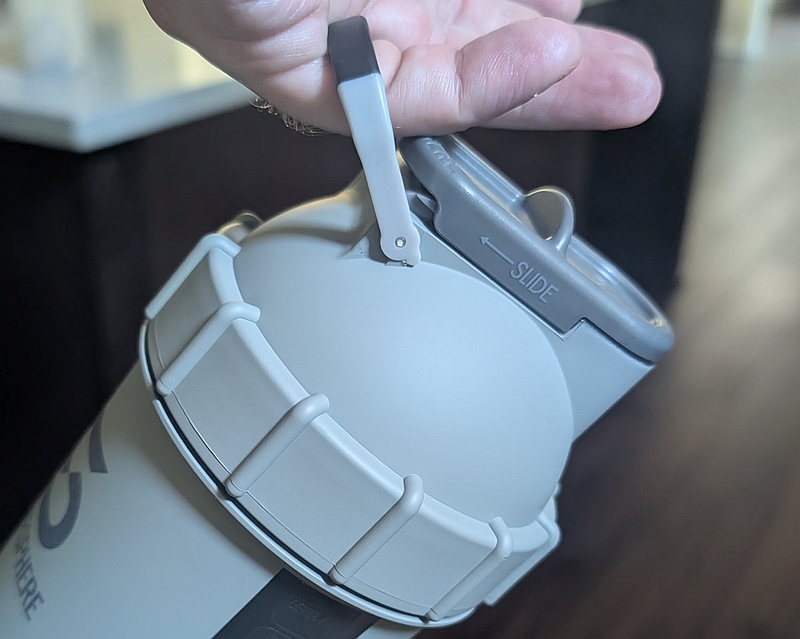

I initially thought the loop was stuck or stiff, but a closer look shows the arm of the loop has a tab to intentionally limit the travel:

It’s a little more comfortable if I put my finger through the loop in the opposite direction, but it still causes the back of the cap to press on my finger.
I frankly don’t know why Shakesphere they did this. If the tab limited loop movement enough to avoid the cap when it’s all the way back, that would at least make a kind of sense. But the stop point seems arbitrary while also providing no benefit.
Noise
This one’s pretty simple: the Shakesphere doesn’t make any noticeable noise in transit, and (by default) the wire ball in the BlenderBottle does, especially when the bottle is empty. If you’re carrying it post-workout in a duffel/bike bag or it’s sitting in the passenger seat while you’re driving, the rattle can get a little annoying. Of course, the BlenderBottle can be silenced by removing the wire ball.
Stability
The rounded exterior shape at the bottom of the Shakesphere’s cup means the part that touches the countertop or other surface is smaller relative to the overall width than a normal cup. As a result, it tips over more easily than the BlenderBottle. This isn’t an issue for me since the bottle is either empty on my counter or on its side in a bag.
Cleanup
The no-corners glossy interior of the Shakesphere makes it easier to clean, and the textured outer is slightly easier to grip when wet.
My one concern is the bottom of the cap slide. It comes into direct contact with the mixture, then when the cap is retracted, it almost touches the top of the lid structure. Seems like mixture could eventually get into that tiny space and dry up.
Price
As of this writing:
- The 24oz Shakesphere View is $25 through their website and other retailers
- I got mine for $13 during a sale on Woot
- The regular non-View Shakesphere is $20
- The updated version of the 20oz BlenderBottle Classic (V2, with rounded bottom) is $10 through their website and other retailers
Final Thoughts
After three weeks of use, I basically wanted the Shakesphere cup with the BlenderBottle lid (it doesn’t fit, I checked). The rounded bottom design did seem to reduce clumping, and the glossy interior made cleanup easier, but little things like the questionable cap seal and weirdly uncomfortable loop became more noticeable over time.
I checked the BlenderBottle site while writing this post, and lo and behold, they basically had that combo in the Pro Series (glossy interior, rounded bottom, snap cap, comfortable loop, smooth threading). The everyday price of the 24oz was $15. I bought two, and after a few uses, I think I’ll be using them without the wire balls.
My assumption: at some point, smaller/startup manufacturers like Shakesphere saw the issues with the corners of the older BlenderBottle models and used their rounded bottom design as a differentiator. Then BlenderBottle copied the design, hence Shakespheres being sold for half price at Woot.

 Evening Latte
Leave a reply to CBell Cancel reply